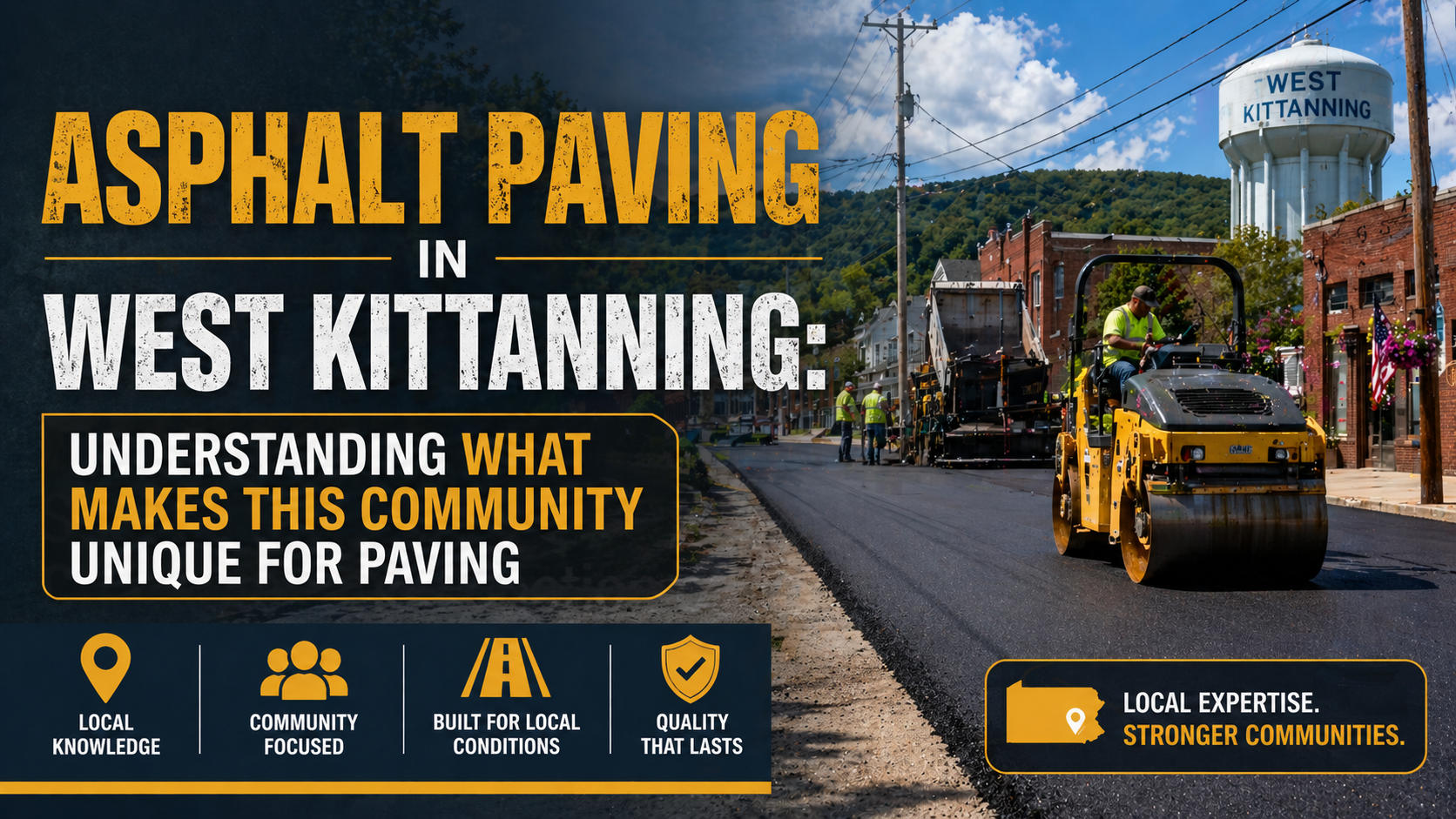
West Kittanning is a quiet borough that sits just across the Allegheny River from its larger neighbor, separated by bridges and connected by the shared character of Armstrong County’s riverfront communities. With its residential streets, established neighborhoods, and the practical concerns of Pennsylvania homeowners who have watched their driveways absorb decades of weather and traffic, West Kittanning presents a distinctive set of paving challenges and considerations.
Understanding what makes paving work in West Kittanning different from a generic asphalt project anywhere in Pennsylvania is the starting point for appreciating why local experience and local knowledge matter so much in this trade.
The Geography of West Kittanning and What It Means for Pavement
West Kittanning Borough covers a modest area, but within that area there is meaningful topographic variation. The borough sits on land that rises away from the river, and many residential properties have lots with graded terrain sloped driveways, terraced access areas, and properties where managing water runoff is a constant consideration. This terrain matters enormously for asphalt paving.
On a level surface, water runs off uniformly and the pavement dries relatively quickly after rain. On a sloped surface, the direction and velocity of water flow must be engineered into the paving project from the start. If a driveway is paved without proper attention to how water will move across and away from it, low spots will develop where water collects, standing water will accelerate deterioration, and within a few seasons the surface will show premature cracking and breakdown that stems not from the asphalt itself but from poor drainage planning.
Experienced paving contractors working in West Kittanning assess drainage patterns as the first step of any project, before any material is ordered or any equipment is brought to the site. Getting the slope right and ensuring water flows away from the property rather than toward the garage, the foundation, or the neighbor’s yard is as important as the asphalt layer itself.
Residential Driveways: The Core of West Kittanning Paving Work
The overwhelming majority of asphalt paving work in West Kittanning is residential driveways serving the homes that make up this community. These driveways come in several characteristic forms, each with its own set of considerations.
Older driveways on properties that have been in family hands for decades may have original asphalt that was installed before modern base preparation standards were commonplace. These surfaces may look acceptable on top while having a compromised sub-base beneath. When an older driveway is being replaced, a proper assessment of the base condition is essential if the compacted stone base beneath the asphalt has deteriorated or never met adequate depth standards, simply overlaying new asphalt on top of the problem will result in the same failure pattern repeating itself within a few years.
Properties with steeply pitched driveways face particular challenges with winter maintenance and material longevity. The combination of freeze-thaw stress, the mechanical action of vehicles gaining traction on cold asphalt, and the surface stress from snow removal equipment means that steep residential driveways in areas like West Kittanning see more rapid surface wear than flat surfaces. Proper mix selection using an asphalt mix designed for durability and resistance to surface abrasion is important for these applications.
Private lanes and longer driveway runs serving rural properties on the edges of the West Kittanning area have their own requirements. These surfaces typically carry less frequent traffic but may need to support heavier vehicles delivery trucks, agricultural equipment, emergency response vehicles that can damage a sub-base that was designed only for passenger cars. Base depth and material specification for these applications differ from a standard residential driveway.
What the Paving Process Looks Like in West Kittanning
A professionally executed Asphalt Paving West Kittanning project in West Kittanning follows a sequence that begins well before any hot mix is laid.
Site assessment is the foundation of the project. The contractor evaluates the existing surface, checks the condition of the base, identifies drainage patterns, notes any access constraints tight lane entrances, proximity to structures, overhead clearances for equipment and determines whether any existing material needs to be removed or whether the project can proceed as an overlay.
Base preparation follows. If the existing base is compromised, the old asphalt is removed and the base layer is repaired, graded, and compacted before new material is applied. This step is where the long-term performance of the finished surface is determined. A well-prepared base supports the asphalt above it; a poorly prepared base allows the asphalt to flex, crack, and fail prematurely.
Asphalt placement comes next. Hot mix asphalt is delivered from a plant while still at working temperature typically between 280 and 325 degrees Fahrenheit and must be spread and compacted promptly before it cools. In Armstrong County’s climate, this temperature management matters. Paving in very cold conditions, when ambient temperatures are low, reduces the time available for proper compaction and can result in a surface that never fully consolidates.
Compaction is the final critical step. The asphalt must be rolled while still hot to achieve the density that gives it long-term durability. Under-compacted asphalt is porous, allowing water to infiltrate and accelerating the freeze-thaw damage cycle that is a constant challenge in Western Pennsylvania’s climate.
Sealcoating as Preventative Maintenance
Once a new asphalt surface has been installed and has had time to cure typically 90 days to a full season sealcoating is the most effective preventative maintenance step available to West Kittanning property owners. Sealcoating applies a liquid sealer that penetrates and fills the microscopic pores in the asphalt surface, forming a protective barrier against water infiltration, ultraviolet light oxidation, and fuel or oil spills that can degrade asphalt binders over time.
Properties that are sealcoated on a regular schedule generally every three to five years depending on traffic and exposure experience dramatically slower surface deterioration than unsealed driveways. The dark black appearance of fresh sealcoat also has the benefit of absorbing solar heat, which helps melt snow and ice faster during winter months and can extend the period in which a driveway is safe and functional after a winter storm.
For West Kittanning homeowners who want to protect the investment in their paved surfaces, sealcoating represents excellent value as a periodic maintenance measure.